From the Scalpel to the Needle: Seymour Haden and the British Etching Revival
Overview
-
December 19, 2025–May 31, 2026
-
European Art Galleries, Level 2, Gallery S202
-
Free for Members
-
Included with admission
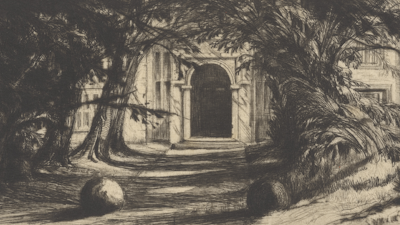
Seymour Haden (English, 1818–1910) was an unlikely leader of an artistic revival. He made etchings as a pastime, a diversion from his responsibilities as a surgeon. Yet, Haden was instrumental in bringing about etching’s popularity across Britain during the mid-1800s.
Haden started etching as a youth while traveling in the late 1830s. But it took another 20 years before he engaged with the technique in earnest. In the intervening decades, he took over his father’s surgical practice in London and began collecting etchings, particularly the work of Rembrandt van Rijn. His marriage to Deborah Whistler, the half-sister of American painter and printmaker James McNeill Whistler, further heightened his interest in the medium.
Haden was drawn to etching’s ease and accessibility, believing it offered a direct means of expressing the mind. Indeed, his work bears an immediacy that suggests he captured scenes from his daily life as they occurred. He was such a passionate advocate for the medium that he founded the Royal Society of Painter-Etchers and Engravers in 1880, which helped inspire an artistic movement and a generation of artists.
Selected artworks
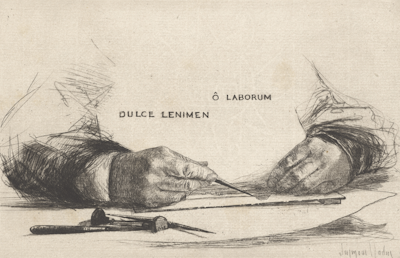
Seymour Haden, Hands Etching–Ô Laborum, published on the title page of the book Etching Studies (Etudes á ’eau forte), 1865.
Etching and drypoint. Plate: 5 7/16 × 8 3/8 in. (13.81 × 21.27 cm); sheet: 7 7/16 × 10 7/8 in. (18.89 × 27.62 cm). Gift of Mrs. Laflin C. Jones M1988.43
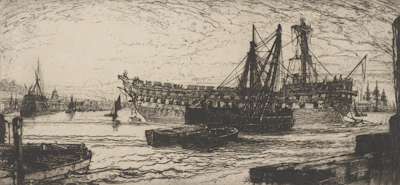
Seymour Haden, Breaking up of the “Agamemnon,” No. I, 1870.
Etching with drypoint. Plate: 7 3/4 × 16 5/16 in. (19.69 × 41.43 cm); sheet: 11 1/8 × 19 1/2 in. (28.26 × 49.53 cm). Gift of the Estate of Katherine S. Dreier M1953.26
Featured events
View all featured eventsLoading...
Upcoming events
View all eventsLoading...
Support
The Milwaukee Art Museum extends its sincere thanks to the Visionaries.
Mark and Debbie Attanasio
Donna and Donald Baumgartner
Murph Burke
Joel and Caran Quadracci
Sue and Bud Selig
Jeff and Gail Yabuki
